
Hello everyone!
I finally found time to write up a wee blog post about our recent workshop “HOW COOL ARE NETTLES” for those of you who enjoyed it, and those unfortunates who missed it! Unlucky- it was awesome. (There’s a TL;DR at the bottom of the blog for those who just want the straight facts.)

On Saturday we were so CHUFFED to welcome everyone down to our sweet new FSL plot at Ravenscraig Walled Garden, where we all huddled together to brace against the slightly pathetic drizzle like a weird breed of plant-obsessed Fife penguins. In the workshop, we explored the weird myths and legends surrounding Nettles, then looked botanically closer into the Urticaceae family, a bunch of hairy, spiky, shallow (rooted) geezers the lot of them! In displaying specimens of the two different types of local Nettle (Urtica Urens and Urtica Dioica), I was surprised and delighted that many took it as an opportunity to have a little squeeze and declare triumphantly, “that doesn’t sting!” before furiously licking and scratching their hands for the rest of the morning.
We laughed that Urtification (the practice of being whipped by Nettles) is used both as a punitive measure by indigenous groups in South America, as well as an expensive luxury treatment offered by fancy retreats in less intelligent parts of the world. Both recipients of the Nettle whipping would receive a healthy dose of stimulating chemicals including histamine, formic acid and a serotonin-inducing compound HT-5. Pleasure or punishment, the body would listen!
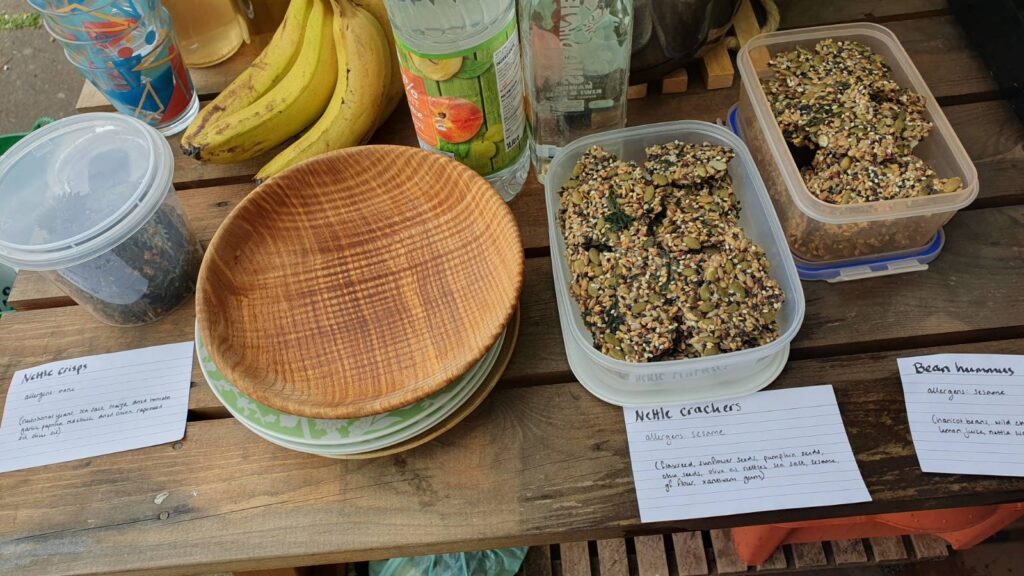
Nettles don’t just end at being biodegradable weapons, you can even eat them! Amy gleefully embraced using Nettles in the kitchen in place of leafy greens for the last month, and treated us all to a bounty at lunchtime consisting of nettle crackers, nettle soup, nettle kombucha, nettle focaccia (thanks Fat Tony!) nettle cordial, and a nettle cheesecake! Stuffed! Containing massive amounts of calcium, protein, iron, plus vitamins A, C and E, these prickly pals should be considered a superfood.

After lunch we looked at how home-made Nettle fertiliser can support healthy plant growth in the garden. Unpacking the predominant nutritional demands of most plants (Nitrogen (N) for leaves, Phosphorous (P) for roots and fruits, and Potassium (K) for general health), we looked at sources easily obtainable in any green wild space, and for FREE. (Fifers love this one trick.)
While Comfrey was the all-round NPK champion, offering decent levels of all three major nutrients, that’s not what the workshop is about, nor does it provide specific nutrients for the various stages of plant growth. Still a wonderful additive.

Nettles make a decent nitrogenous fertiliser, so would really suit leafy greens and the leaf-developing stage of plants, but you shouldn’t give too much otherwise leaves are all you’ll get! Applying a light scattering of coffee grounds to the topsoil around about plants in their flowering stage, or by the roots while planting would gradually impart phosphorous, supporting healthy blooms and fruit development, but again, not too much as coffee grounds can be acidic! There’s never a bad time to offer a dose of Potassium, and just like us, plants can find this in bananas. Soaking the chopped up skins in water for a few weeks will create a lovely tea that your plants will drink up happily. With all liquid fertilisers, we recommend a diluted dose of 1 part fertiliser to 10 parts water, but you can eyeball it as long as you err on the light side. “Weakly, weekly” is a useful homonymic mnemonic.
We mused on the benefits of chop and drop, where plants are left to rot down on the soil (nice and easy but unsightly and uneven), as well as the well-known “steep leaves in water until the smell ruins your life and gets you an ASBO” method, then delved into the hi-tech but as yet, unsuccessful method of a pipe press, where chopped leaves weighed down with a bottle are (allegedly) supposed to rot and produce a high strength, odourless concentrate. I think we need much more time to see results on that method as our climate is colder than most. Watch this space.
THANK YOU to everyone for joining us in celebrating these wonder plants! Watch out in the next few weeks for the grape-like seed clusters to form on the tips of the Nettles- these can be picked, dried and stored, and are chock-full of nutrients! Yeet!
K x
TL;DR
Apply all liquid fertilisers in a 1:10 ratio, weekly during growing seasons, to the soil around the plants, not directly on the leaves.
Soak chopped up Nettles for 2 weeks in water for a Nitrogen Fertiliser that’s good for leafy greens.
Soak Banana Skins in water for 2 weeks for a Potassium Fertiliser that’s good for general plant health.
Scatter Coffee Grounds- a source of Phosphorous- around about any plants that are in their flowering stage to support healthy blooms and fruit formation.
Soaking Comfrey in water for 2 weeks will produce a great all rounder fertiliser, but won’t be tailored to your plants’ specific needs at any given time.
All of these materials can be chopped and dropped directly onto your garden beds, or added to the compost pile to enrich the mix.
