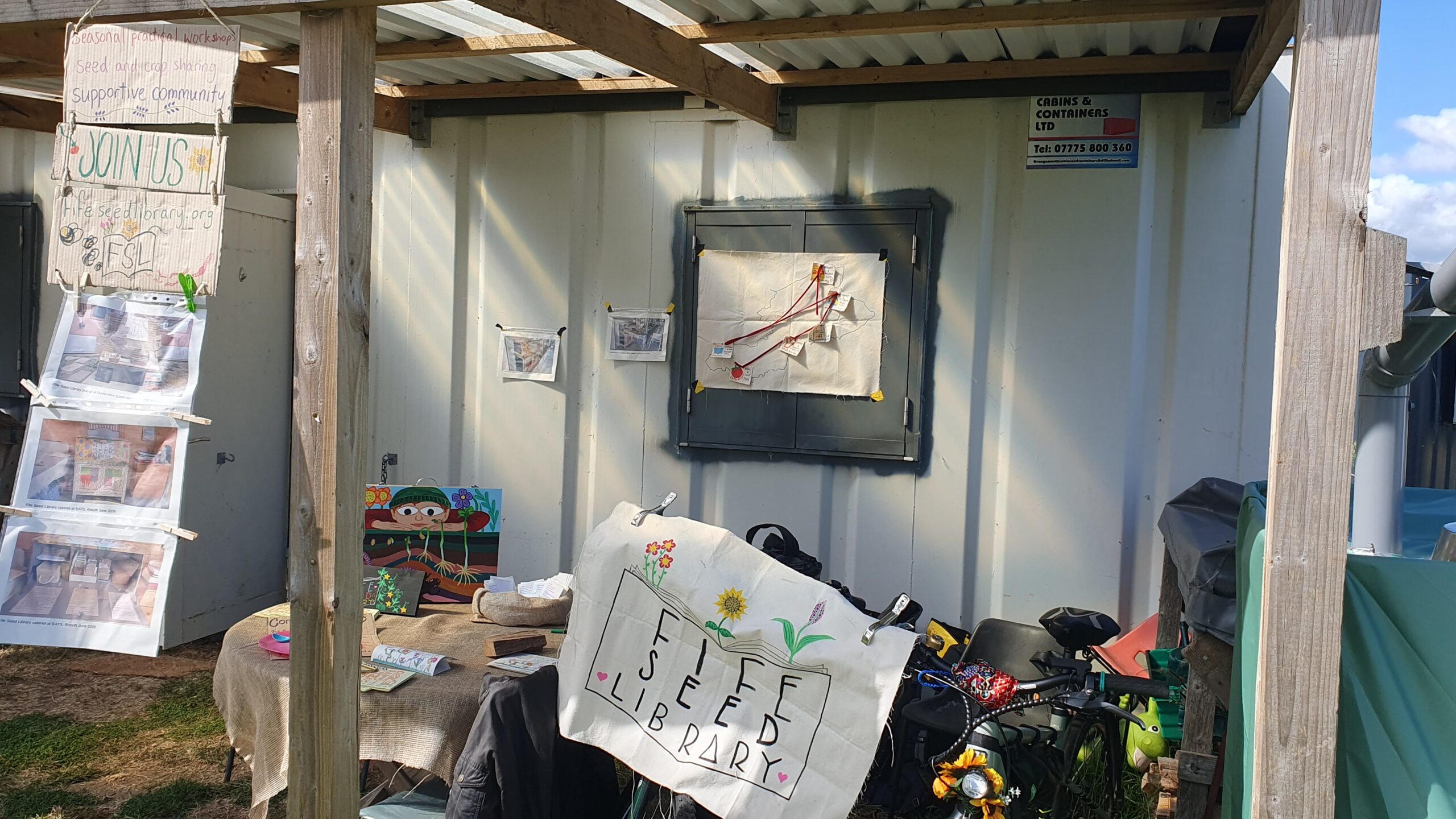
We’re rosy cheeked and cheerful after spending a sunny day at Lauriston farm this weekend, celebrating seeds and their stories with a bunch of cool cats from all over Scotland.
The Scottish SeedFest 2026 was an eclectic event organised by the Gaia Foundation, and ran as part of a two day event (the other day being all about grains) with a variety of seed-centric activities, captivating speakers, super-serious silent tomato tasting sessions (no joke) and loads of time to chat with new friends who are also spreading the good word on seed sovereignty and home growing.
It felt really exciting to pedal along to the farm with our portable seed suitcase strapped to the back of my bike, a random selection of seeds to share and swap, and Amy’s rad new canvas map folded up in the panniers. Sun through the trees, blue sky, half bottle of Irn Bru in me. Exciting until I felt the rim of my back wheel clanking on the road as I made a turn. Puncture. Two minutes from the farm. Such are the hazards of a super mobile, bicycle-powered seed library. It’s worth it though.
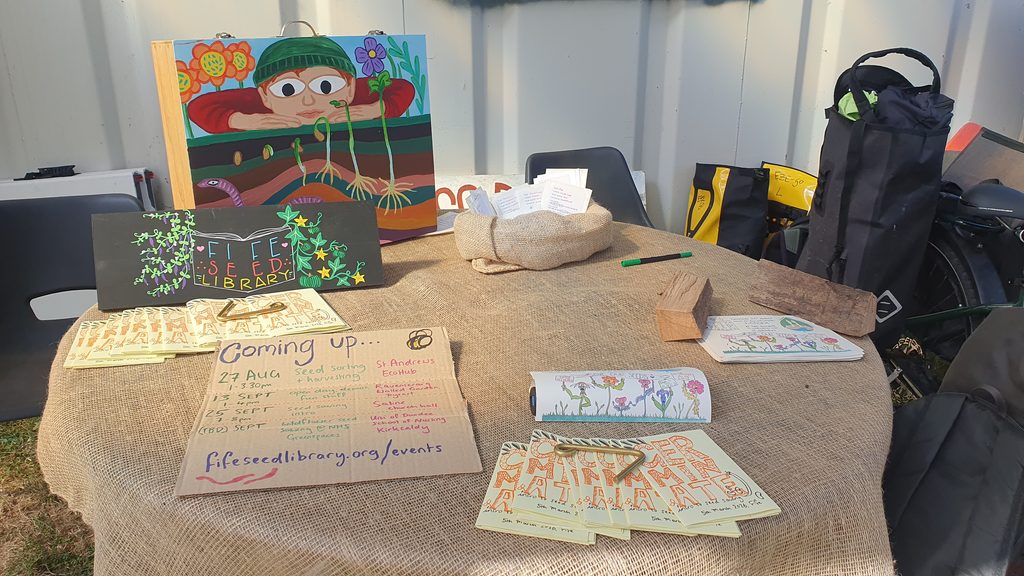
Arriving somewhat gingerly at Lauriston to strong coffee presses piping and a generous selection of baking on the tables, Amy set up our table while I flipped the bike and changed the tube. The chatter I overheard while I worked made my heart skip a little bit; people were discussing seeds and plants and justice and futures. Someone mentioned Bayer with a low edge to their voice and a hiss followed. Nice crowd. My kind of crowd.
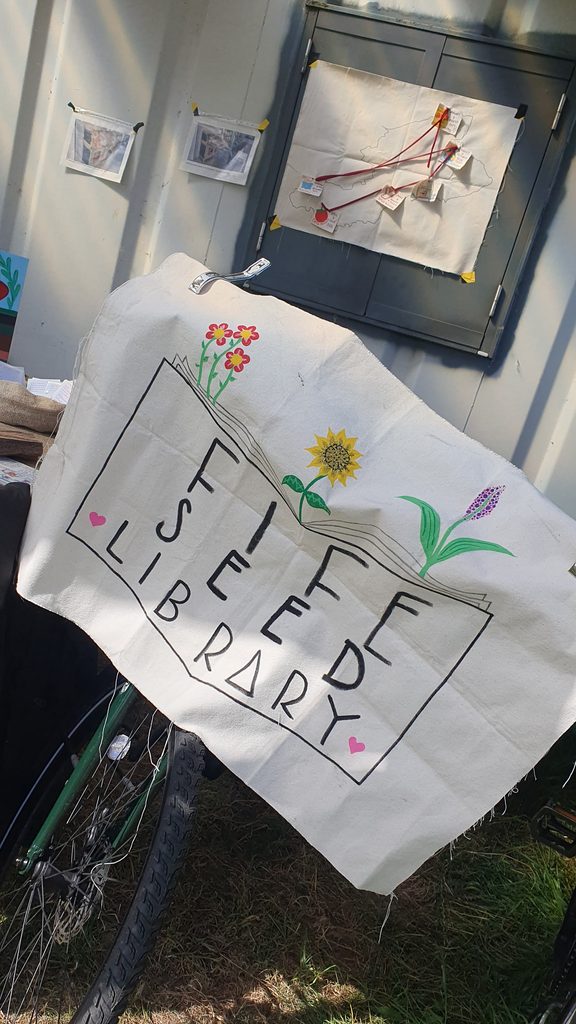
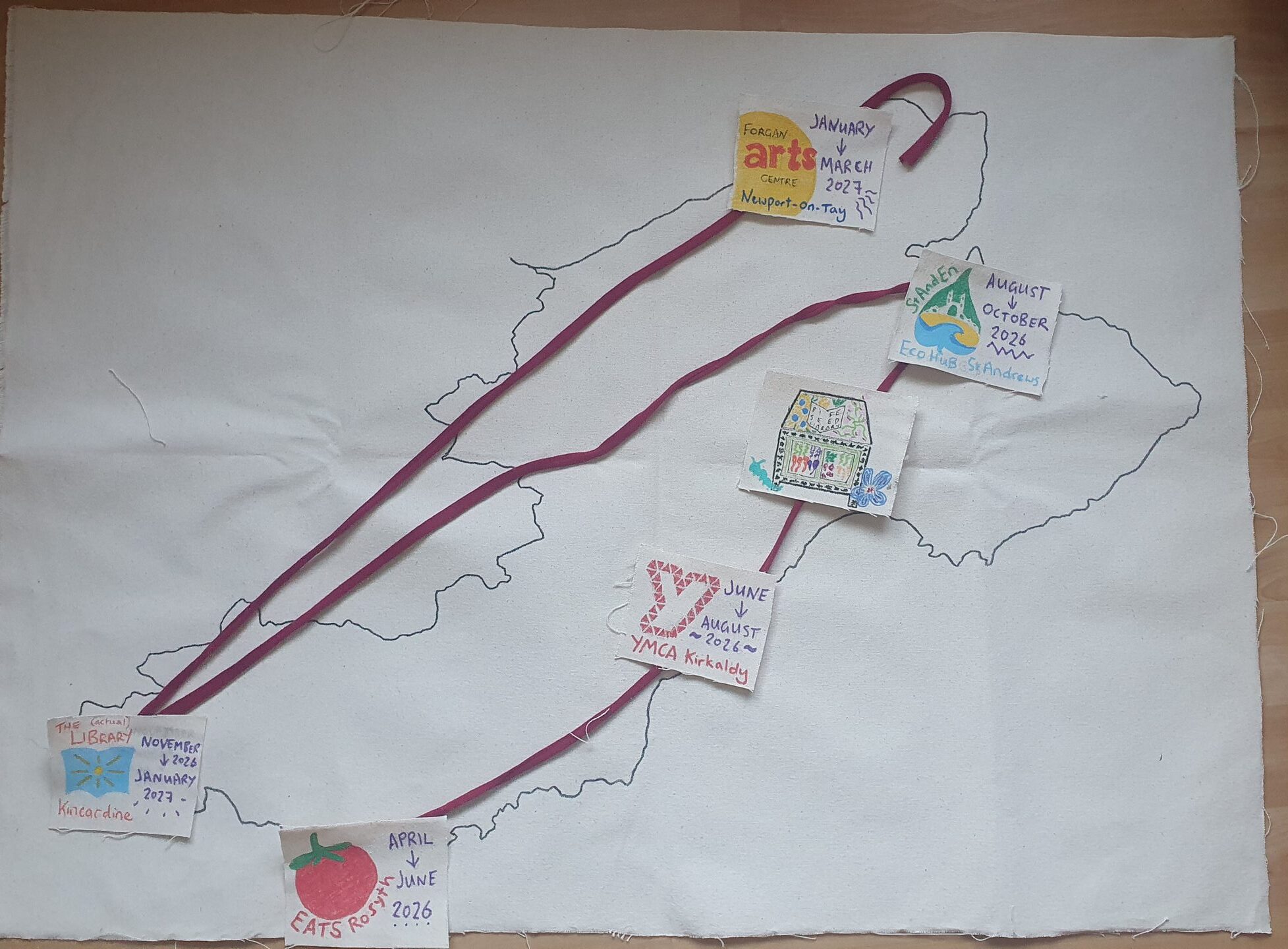
Amy’s rad canvas map is a beautiful (and geographically precise) representation of Fife (dug’s heid) showing all the places that our semi nomadic seed cabinet has been and is going to! There are cute little squares with the logos of our hosts, and it’s all strung up in a very authentic Indiana Jones style red line and dots motif. The table was all set up when I came over and saw it all fluttering so charmingly in the breeze. I love fabric, and our handmade signs get so much positive attention, as well as being so very portable!
So the map motif continues, right? A Dutch Cowbell rang (clunked) and we were all invited to do a little icebreaker game spreading out and standing in a rough map of Scotland based on where we’re from. Seeds of Scotland were representing in the high north of Aberdeen, and a smallholder deep in the southern weeds was repping Kirkcudbright on the Solway Firth. East coast was positively rowdy around Fife, and we met our county contemporaries who are engaging with growing and seedsaving in their own ways.
The first of the day’s speakers, researcher Cat Scothorne was popping off with this tremendous rundown of the last 400 – somewhat dark and shit – years of seed history, really digging into the injustice, power struggles, exploitation and manipulation that have shaped today’s food systems. The broad exponential movement of humans across the world has spread seed far and wide, like the good little mammalian seed vehicles we are, but the most shocking stories are the ones where we can’t share. Too many wars, too many tales of powerful groups flexing their might onto other, weaker groups, using food as a tool of control.
Agnes Taiti of Lauriston Community Garden gave us a fairground treat with a crankie show and a moving story of Women, Beans and Resistance in the central highlands of Kenya. Rolls and rolls of decorated canvas trundled by as Agnes told us about how beans are a vital part of the diet in the area as other sources of protein are scarce. The vast variety of beans that were in circulation prior to any colonialist influence were astonishing, and many carried deep meaning and associations with fertility. Certain beans were favoured for their many culinary properties, however some were specifically reserved for a significant dish that would be served to future in-laws at a marriage ceremony. Beans were how. Beans is how.
What happened when this region of Kenya was interrupted by colonial occupation is an injust and all too familiar story, but the loss of life, diversity and liberty was felt by both the people and the plants. Resistance stirred amongst the people however, and subtle, intelligent, decisive moves were made to thwart the yoke of control placed on a once vibrant, liberal growing region in Kenya as well as among the displaced in the Caribbean. We heard of beans woven into braids for smuggling, covert sowings of rival varieties within the monocrops to upset the order, and wild sowing of food crops in forests to supplement the diets of escapees and the resistance. They succeeded in securing their future, however many varieties of beans, too long shelved, had been lost.
Agnes proudly led the party up towards her allotment where mighty bushes of perennial kale stood trunked thick into the soil and their rich blue green leaves barely let sunlight through. Naturally, there were a number of bean crops sown, and in the tunnels she was growing melons and cucumbers with some crazy delicious basil. We crunched a couple of crispy ol’ radish pods, which ate like a fresh chilli except with a mustard-peppery profile. Very satisfying.
Lunch provided by Madan was a generous Nepali spread and included pakorae, momos, three types of stew, a rich dish of whole new potatoes, and some of the most exquisite spicy tomato dip. I was in hog heaven, and went back for seconds. Absolute legends, we adored the food, Dhanyabad, Dhanyabad, I am going to be dreaming of momos forever now, why were we even at this thing in the first place? Oh yeah seeds!
The next activity after lunch was a co-design session with The Scottish Seed Hub. We brainstormed, in groups, about how a seed saving network membership model might be adapted to be accessible, scalable, and potentially profitable, so the Hub can be self-sustaining. Thoughts flew around and notes were made, everyone in the similar vibe of ‘it feels like it should be simple’ and ‘why aren’t we actually doing this already’. Turns out, public engagement when it comes to seeds, growing and future-proofing aren’t the hard part. It’s making enough money to support such a venture in a system weighted in favour of profit.
Conversely to what the current food system might look like right now with shortages and rising prices, our group was able to agree that there is an intelligent model for abundance within Nature. One tomato plant might produce 50 tomatoes in the season, and one tomato might contain 50 or more seeds, plus delicious flesh that gives us vitamins and water. That’s approximately 2,500 seeds, from one plant, plus food for a few months. So why is there a struggle to afford food?
Once we had made our best group effort to draw up a dynamic progress model that set the weird money-hungry world to rites, Seeds of Scotland treated us to a very serious tomato tasting. Cuts of four different tomatoes were laid out and marked A to D. Our instruction was to sample each, review the overall enjoyment of it, and rank the four in order of preference. It was to be done in silence, with utmost focus and sincerity, and I was very glad to see that every one of us there took it as our scientific duty to introspect and get vibing with our taste buds. I ranked C,D,A,B, because one had a rank tough skin, and one just had zero going on The other two were whimsical journeys of pure flavour and sensation though, at first taking me to a smoky bonfire, next to some kind of tropical melon palace. One of them, I swear, the skin just melted on my tongue. I was like, ‘where is it? It’s melted.’
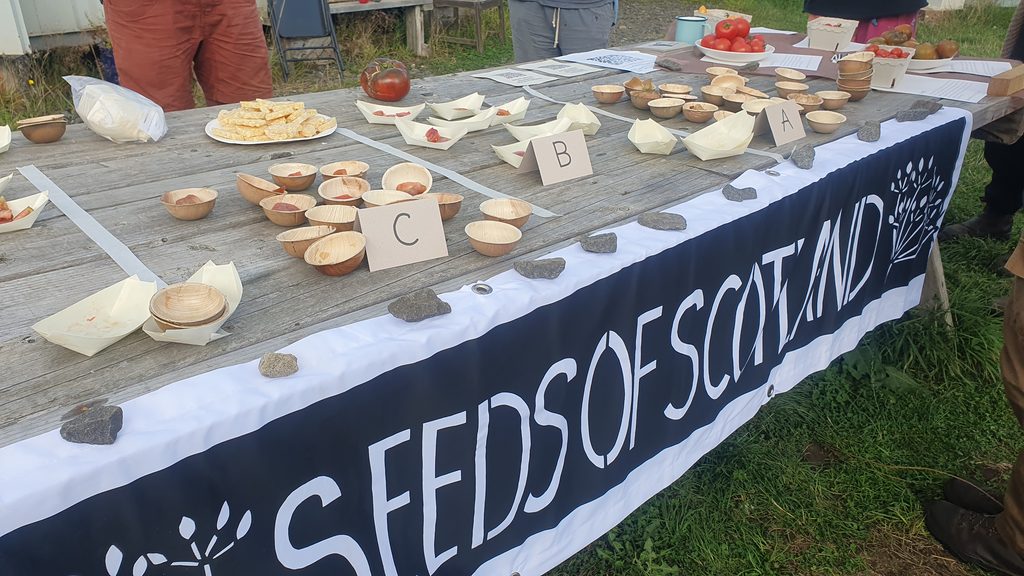
Our collective votes were tallied, and the results will inform the choices that Seeds of Scotland will make when it comes to selecting traits and varieties within future seed crops. Changing the world, huh. All in a day’s work for a tomato taster.
Holly, of East Neuk Market Garden and member of the Gaia Foundation, explained to us all her specialism and fond appreciation for crowd breeding, or flock cropping. It’s all about mixing up lots of different varieties of plants that all have appealing traits individually in a bed, and through promiscuous pollination practices (wink wink), they all swap genes and create new generations of diverse, resilient plants that will be all the better for the wider gene pool in the long term.
Lisa took us on a swift tour of the garden and showed us some IRL flock crops in the form of a luscious row of chunky shiny wobbly kale all mixed up with heaps of differing shapes and colours, and a complicated carpet of squash, no two alike, spreading freely across the plot in all directions. Lisa is one of a group of other growers who have undertaken to grow a selection of crops for seed using this wonderfully chaotic format and recording the findings – including taste testing squash.
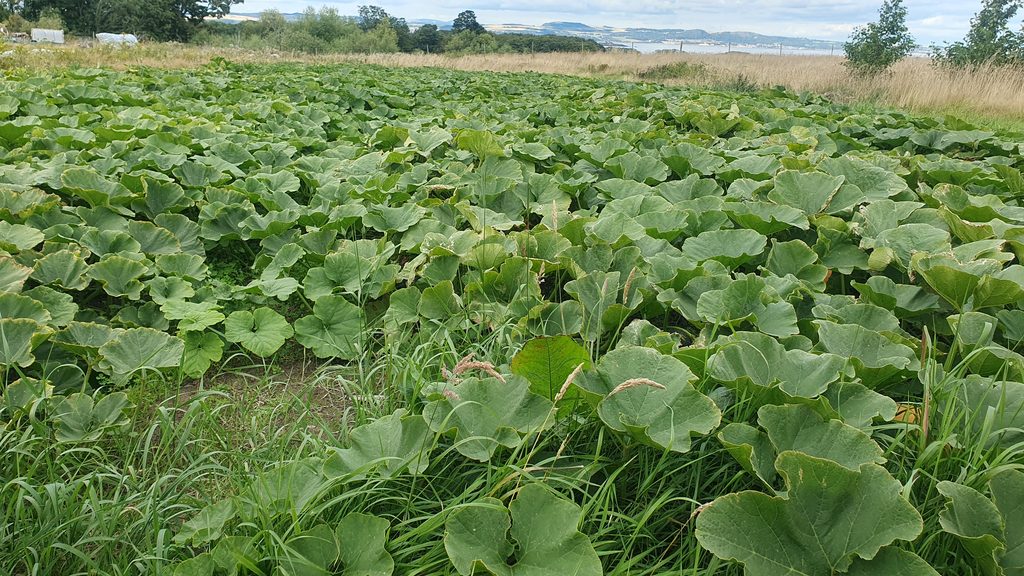
I had a feeling after seeing the field with all the different squashes that it was kind of like a painter’s palette, where little smudges of colours can blend, or overwhelm, compliment, or disappear. By accident, intention or experimentation, change happens. Maybe that’s a very basic view of the complicated genetical crossbreeding that’s going on in there, but the way that Lisa and Holly talked about ‘bringing more blue back into the the flock’ by adding a blue giant pumpkin into the mix, it just felt right.
What a day. Massive respect to everyone and huge thanks for the invitation, for organising it, feeding us, teaching us and inspiring us. I can’t wait to see what we all do in the coming years!
Leave a Reply