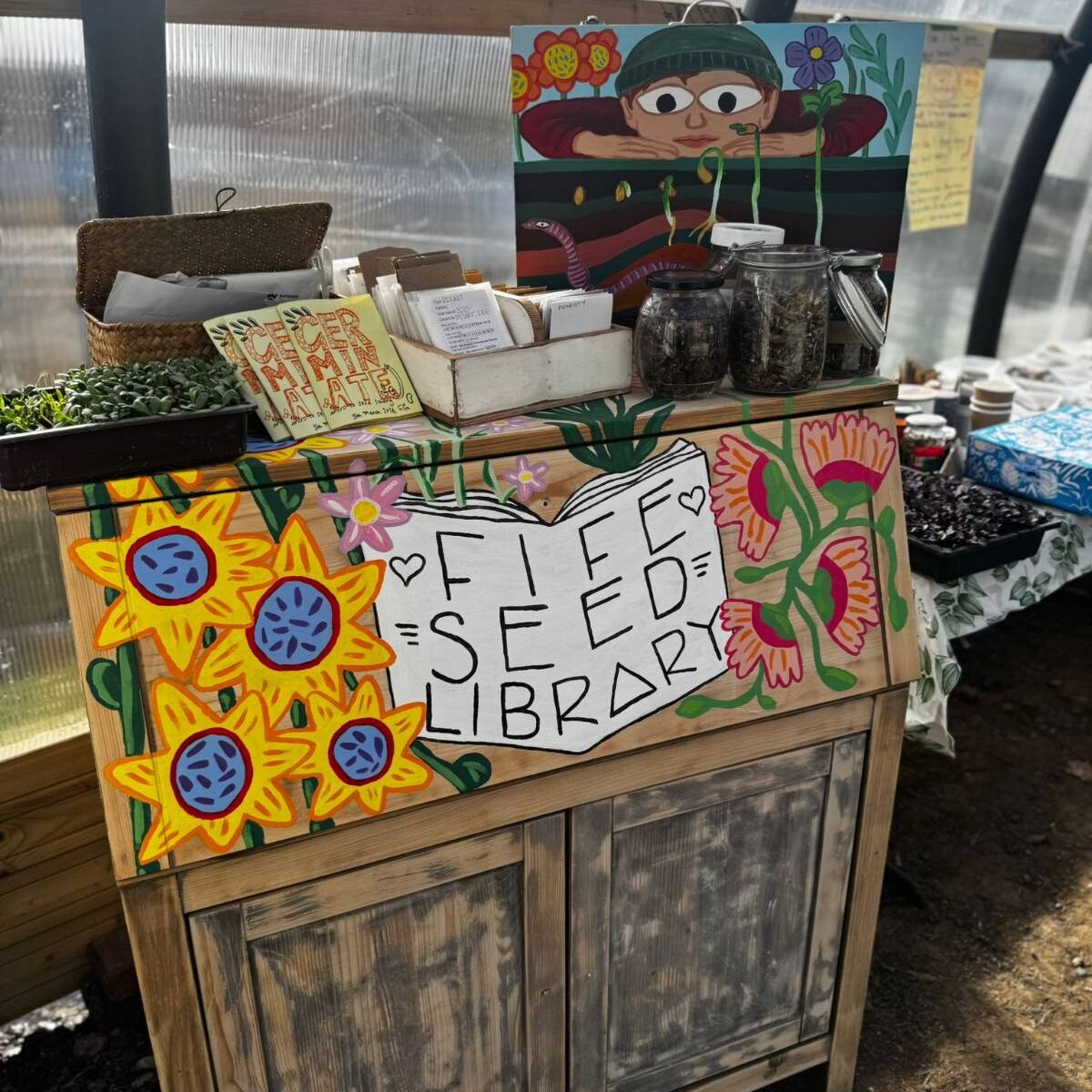
We held our first ever Seed Swap in the new polycrub at EATS Rosyth on Saturday. Thanks to FCCAN for the funding that made this event possible! The polycrub itself provided an additional layer of magic, with intervals of golden sunlight warming us through the sides, punctuated by the comforting drumming of passing rainshowers.
Thanks to all of you who came along to support and swap seeds from as far afield as Kincardine and Glenrothes, and all around West Fife.
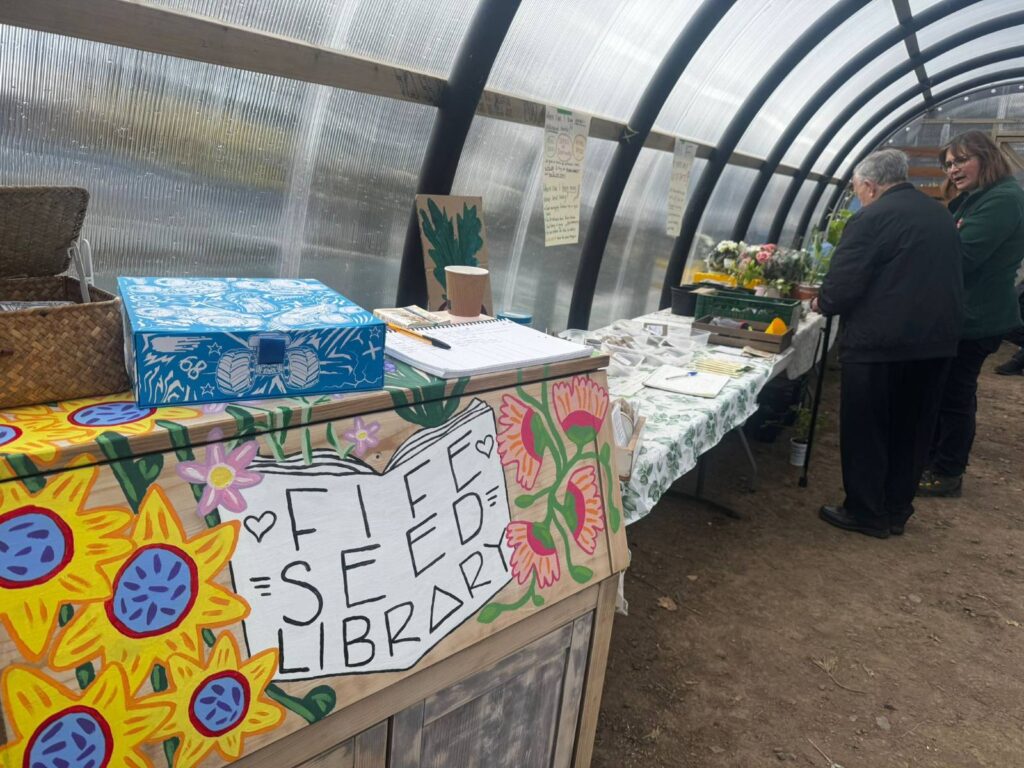
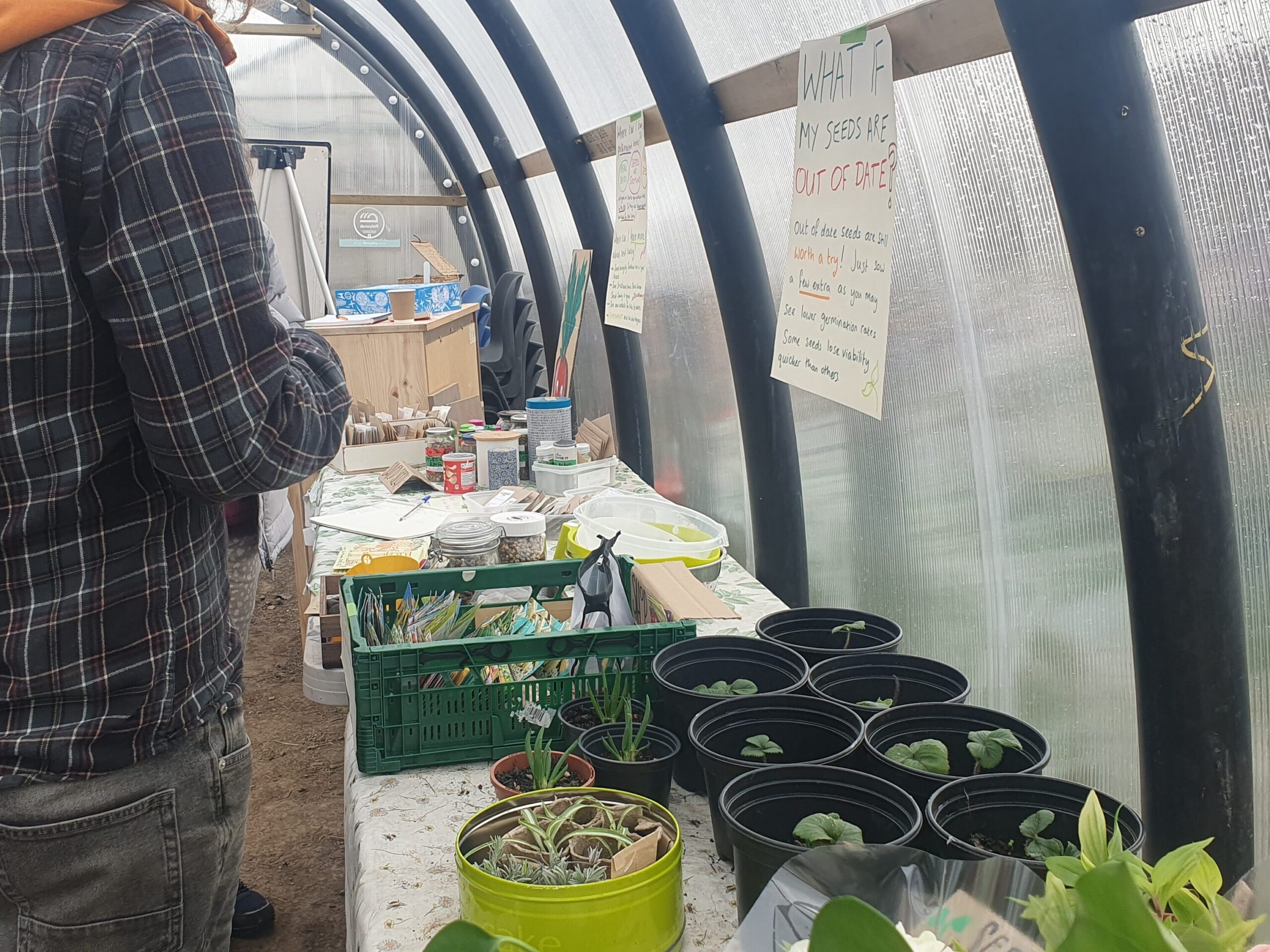
We had loads of interest from the local community and made some fantastic connections with other initiatives, as well as potential future hosts for the seed cabinet. It was pure joy when people pulled envelopes out of their pockets full of open-pollinated seeds they’d been saving with family members for generations (of people and the plants!) – who didn’t realise how important what they’re doing is.
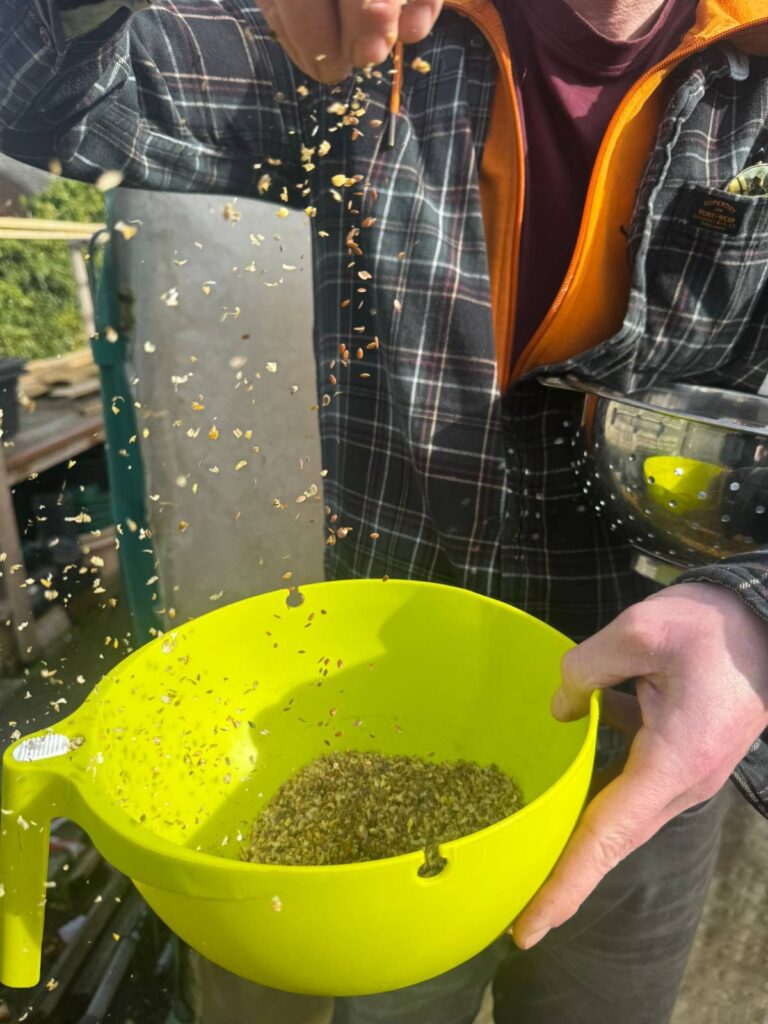
We also shared seedlings and houseplants, handed out seed zines, and Kit winnowed flax seeds live and on-demand with a colander and a gentle breeze!
Over the course of just three hours, 22 very large packets of saved seeds were checked in to the library, and 35 packets – from flowers to tomatoes to beans – were checked out, with their borrowers pledging to save seeds from their crop and return them to the library next year.
Refining the process
It was also an opportunity for us to test out and refine our checking in and checking out process.
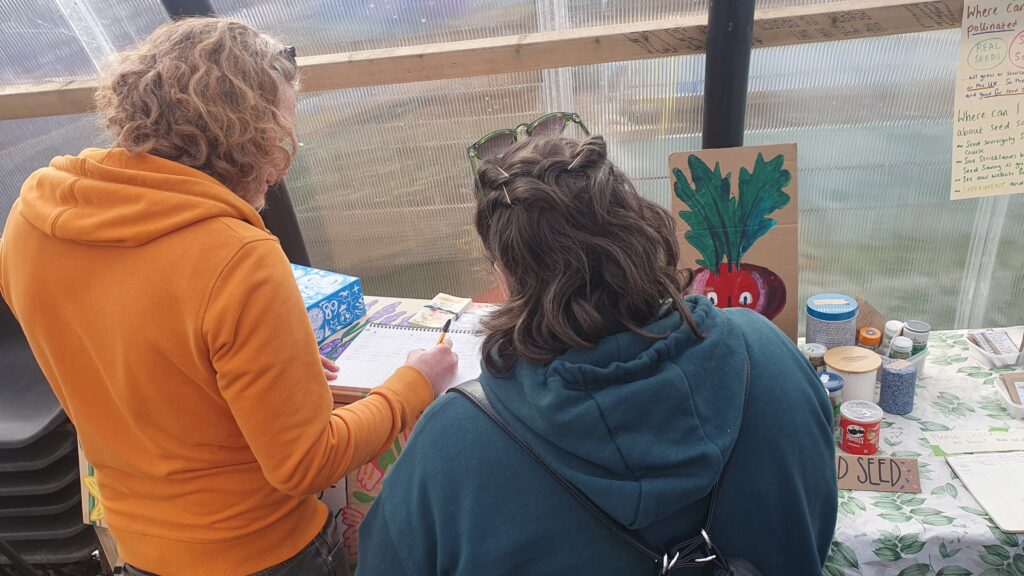
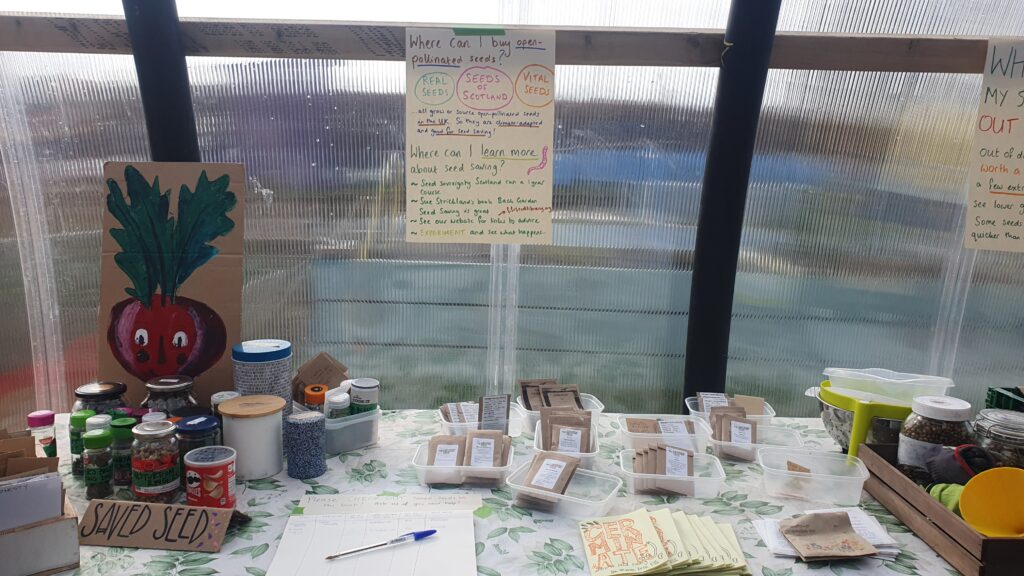
We’re using notebooks and pens to record seeds borrowed and lent. We’ve decided not to digitise the process for a couple of reasons:
- We’re not always going to be at events where we can keep a computer plugged in, and the extra work of synchronising paper and digital records is just not something we can keep on top of as volunteers.
- At the moment we don’t need to make charts or create statistics about library usage.
- At our current stage it is easier to share access between our volunteers to a physical notebook than a digital file.
- We just love physical stuff. We hand-draw our signs, zines and artwork. There’s something about touch and the act of writing that connects us to what we’re doing in a way a keyboard just doesn’t.
We – or someone we’ve trained – will always be present to help with checking seeds into and out of the library though. So if scribbling with a pen isn’t your thing for any reason – you’ll have a live human to talk to instead.
We make a point of recording information about the seeds, not the people! We don’t want to hold any more data than necessary. We ask people for their names, but that is purely optional. If you want updates from us, the best way is to join our newsletter or register as a member.
Borrowing seeds
We’ve decided not to limit how many packets people can take, and there’s no requirement to bring seeds in order to take some. However we want to do whatever we can to encourage people to sow the seeds they take.
We haven’t spent hours processing, packing and labeling so that the seeds can gather dust in someone’s shed! We’re designing our library process, as well as the informational materials and our workshop programme, to make sure as many of the seeds we give out end up being grown to maturity as possible.
We record seeds that are borrowed (or checked out) of the library so that we can keep track of where things are being planted around Fife. We like to know how many packets people take, so when we’re applying for funding we can talk about how many people have already benefited! There’s also a gentle nudge on the form to prompt people to save and return some of the seeds from their crop.
Lending seeds
Slightly more involved is the process for checking seeds in to the library.
We ask for the type and variety of the seeds, so that people know what they’re getting. If you’re not sure, or think you might have a hybrid (for example, if you grew lots of kinds of brassicas which might have cross-pollinated with each other) we’ll still happily accept your seeds – we just need to label them as possible mystery seeds – and then it’s up to borrowers to take their chances!
It’s extremely useful for us to know where the parent plants were grown, so borrowers can choose seeds grown in a similar (micro)climate to where they want to sow them.
We ask for the year saved because some seeds lose viability over time. We never throw seed away, but for older seeds it’s good to sow a few extra just in case.
It’s important for us to know the parent origins of the seeds being checked in. This lets us filter out offspring from F1 hybrid plants – for example, if you bought a tomato plant or seeds from B&Q, grew it to fruit and saved the seeds – the seeds produced might not be viable for growing on another year. We don’t want to inadvertently give these out to borrowers. On the other hand, if you’ve been saving seeds for ten years in your garden and are kind enough to offer some – that’s really exciting! They’ll be well-adapted to our climate, so will probably do really well when someone plants them. We definitely want to record that.
Checked in seeds go into our deposit box, and – if not already – the packet they were brought in is labelled so we can match it up with the row in the notebook. We (Kit, Amy, and other volunteers) will periodically sort through the deposit box to package the seeds into suitable quantities, and label them. (If this sounds like something you’d love to help with – let us know!) The seeds will then be available for others to borrow.
If you came along on Saturday and have any feedback or suggestions for us about the process, we’d really love to hear from you.
Shop-bought seeds
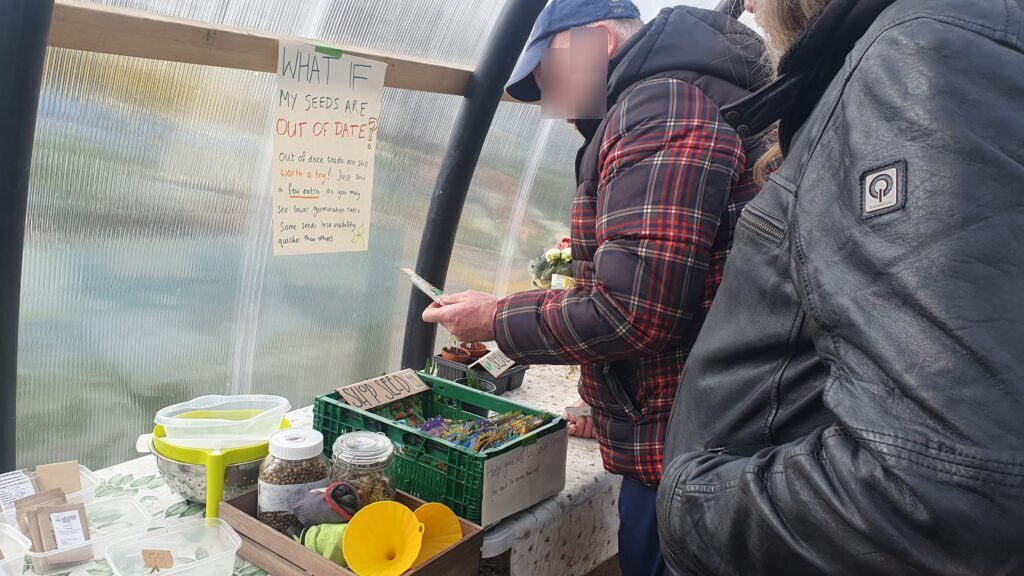
The Seed Library is primarily for building a collection of open-pollinated seeds, grown in Fife and saved by our local community.
However, we also know that many people have accumulated packets of shop-bought seeds over the years and want to share these! We don’t want any barriers to people growing food, and while a lot of shop-bought seeds aren’t good for seed saving, they are good for producing one generation of food or flowers.
When people bring us shop-bought seeds we will still gladly accept them. These don’t need to be checked into the library – we’ll simply add them to our sharing box, which will be available for anyone to take from – without needing to check them out – at our seed swaps.
Pop-up seed swaps
People were really excited about pop-up seed swaps with our Seed Suitcase. We’re looking into funding options to make this possible for as many communities as possible, because we would LOVE to come to you.
Send us an email if you’re having a community event and would like us to be there!